


Bonsai Show Leersum: in search of Jeroen’s very first Bonsai
Anyone who thinks that KoiQuestion is all about koi may be missing the most beautiful part of the hobby: the door to broader Japanese culture. Because sooner or later the paths of koi and bonsai cross. During the Bonsai Show in Leersum, organized by the Bonsai Vereniging Midden-Nederland, we delved with Jeroen into a world of miniature trees, tranquil landscapes and people who sometimes have been working on one living composition for forty years.
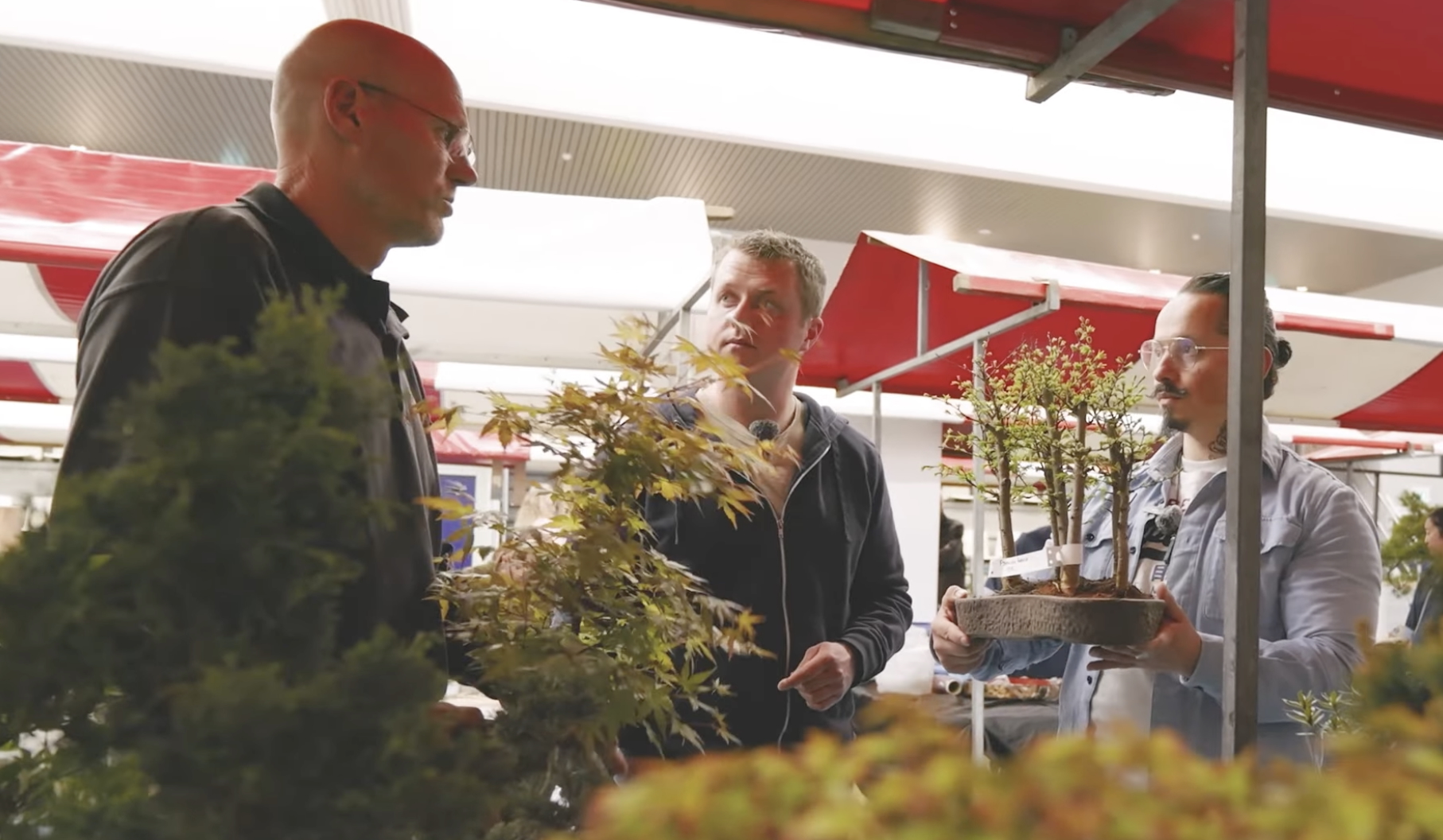
In the Sports and Cultural Center De Binder in Leersum, hundreds of bonsai were carefully presented. Not as plants, but as living works of art. Complete forests on a scale, weathered trunks reminiscent of ancient mountain landscapes and subtle “front gardens” – the so-called kusamono or accent plants; which completed the story around the tree.
From koi to bonsai: same passion, different form
What struck us immediately was how similar the bonsai world is to the koi world. Again, it’s all about patience, development, aesthetics and above all: passion. Like koi, trees are judged on balance, appearance, character and presentation. Some bonsai were on raised tables in almost theatrical arrangements, as if you were watching a miniature set from a Japanese movie.

And just like at a koi show, we met professionals here. People who talk for hours about proportions between trunk and pot, the direction of a branch or the right moss covering around the root base. Because yes, we learned that too this day: a bonsai pot is never just a pot. The height of the pot must be proportional to the thickness of the trunk and the look of the tree. A powerful tree requires stability. An elegant tree, on the contrary, requires subtlety.
“A bonsai is not actually a tree … but a feeling that you are trying to hold on to,” he said.
Jeroen looks for his first Bonsai
The adventure began with one simple question: where do you start as a beginner? Together with Jeroen, we toured the stands in search of his first bonsai tree. Along the way we talked to members of the organization, experienced growers and passionate hobbyists who took us into the world of styles such as Chokkan (formal upright), Moyogi (informal upright) and forest plantings that suggest entire landscapes.
We also learned about popular starter species such as the Acer palmatum (Japanese maple), Chinese elm, Juniperus and various pines. The Acer in particular managed to impress with its sophisticated leaf texture and seasonal colors. A tree that looks beautiful, but also requires attention in terms of location, pruning and water management.
Tools, thread and hard choices
A bonsai does not arise by itself. Behind every tree is craftsmanship. We saw demonstrations where trees were completely pruned, shaped and wired. With special tools such as a concave cutter, jin pliers, root shears and aluminum bonsai wire, trees were guided step by step toward their future shape.
And therein lies perhaps the most exciting aspect of bonsai: making choices without certainty. Because once you cut off that one branch, there’s no going back. Only afterwards do you see whether it was the right decision. That makes bonsai at once art, craft and an exercise in trust.
The dark bonsai labyrinth
An unexpected highlight was a specially constructed bonsai labyrinth. In complete darkness, visitors walked past subtly illuminated trees. The light not only changed the atmosphere, but also the character of the trees themselves. Some looked mysterious and powerful, others fragile and hushed. It proved once again that context does everything; just like koi.
Sushi, stories and recognition
Between the trees, we enjoyed fresh sushi prepared by a Japanese chef and his daughter. Meanwhile, we struck up conversations with visitors, exhibitors and even some koi hobbyists who recognized us from KoiQuestion. That felt special, but actually logical. After all, anyone who immerses themselves in Japanese gardens, bonsai or koi will sooner or later encounter the same love of detail, tranquility and beauty.
At the end of the day, Jeroen finally managed to choose his first bonsai. A wonderful step in a hobby in which you never stop learning. And honestly? Maybe we have become a bit infected with the bonsai virus ourselves. I am still putting it off a bit, but sooner or later there will be one and thanks to Jeroen’s experiences and the open attitude of people who are happy to tell you about it at the Bonsai market; it doesn’t feel so scary anymore, this bonsai world.
Thanks to Bonsai Vereniging Midden-Nederland
We want to support the Bonsai Association Middle Netherlands thank you for the invitation and warm reception during this wonderful bonsai show in Leersum. Thanks to the passion of the participants, volunteers and visitors it became a day full of inspiration, knowledge sharing and admiration for Japanese craftsmanship.
And who knows … we may just continue to follow the development of Jeroen’s Acer in the future.


